Realistic data generation
A time-inhomogeneous Markov process learns time-varying parking transitions and synthesizes occupancy patterns with contextual signals.
 Judith Njoku-Vowels
Predictive smart parking
Can a parking digital twin move from showing what is occupied now to helping operators anticipate what happens next?
Presented virtually at ASCE i3CE 2026
Why I built it
PANDA is a lightweight digital twin framework for predictive management of retail parking facilities. It addresses a practical problem: smaller deployments often lack long historical records and cannot support large forecasting pipelines.
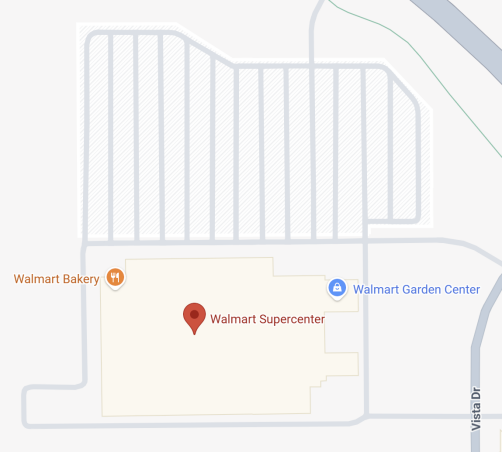
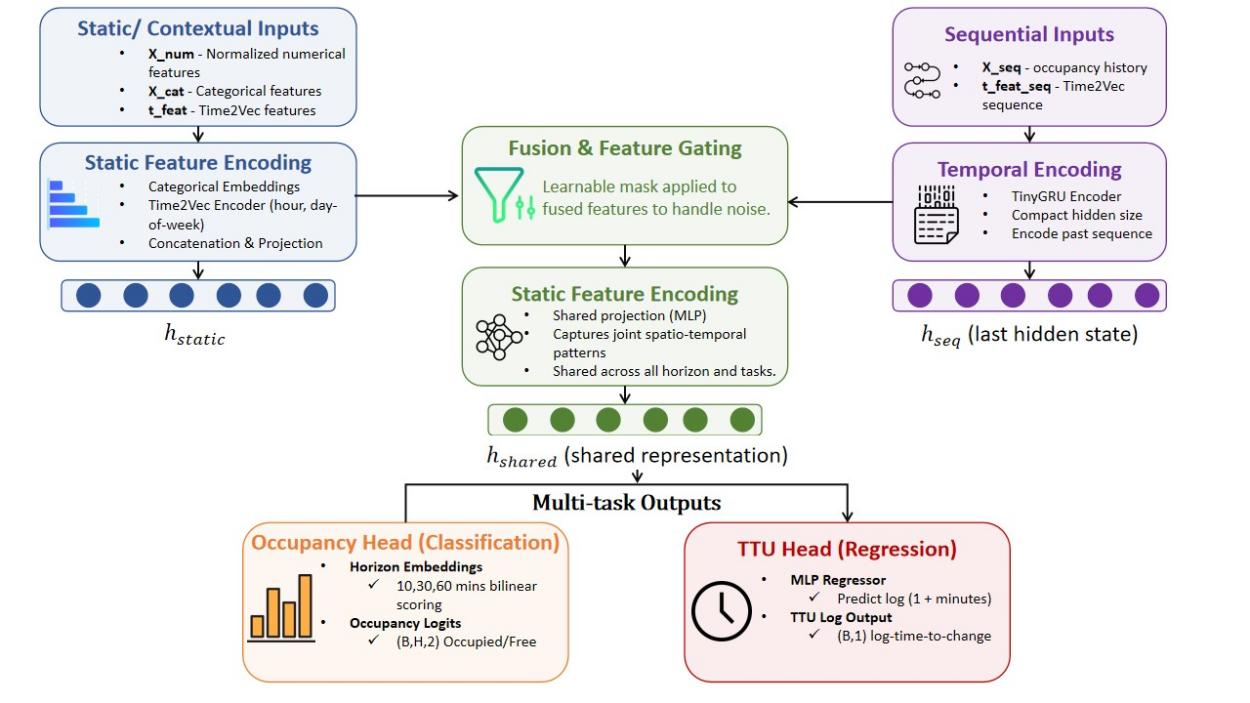
The framework connects synthetic data generation, a compact multi-task forecasting model called P-LiteNet, and a geospatially accurate Cesium environment. The result is a twin that visualizes both current and predicted parking states for operational decision support.
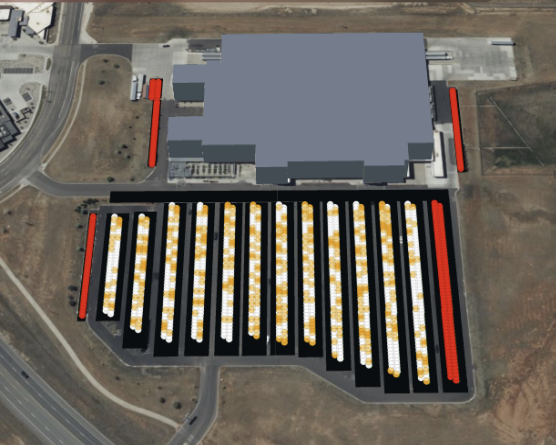
The Cesium-based facility twin maps predicted states to parking modules and individual spaces for rapid operational interpretation.
How the system works
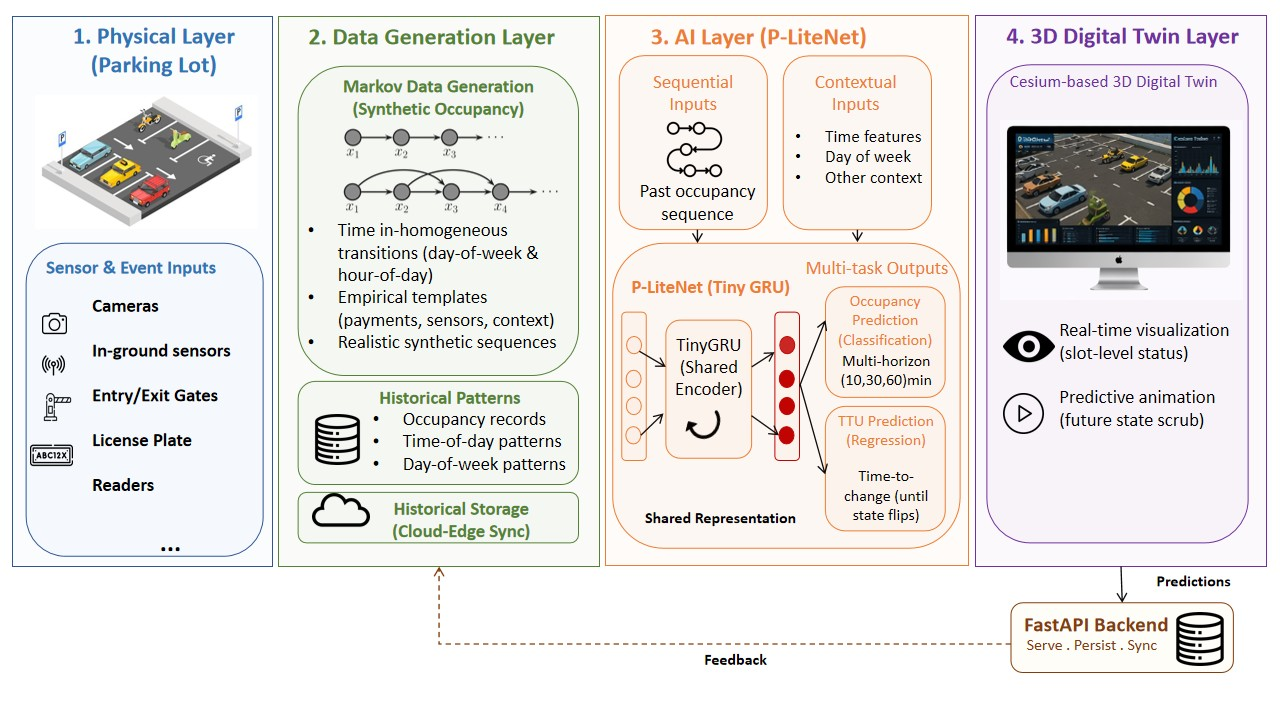
A time-inhomogeneous Markov process learns time-varying parking transitions and synthesizes occupancy patterns with contextual signals.
A 156K-parameter TinyGRU architecture jointly predicts multi-horizon occupancy and time-to-change instead of maintaining separate models for each horizon.
Forecasts are synchronized with individual parking entities in a 3D geospatial environment for slot-level and module-level exploration.
What this work contributes
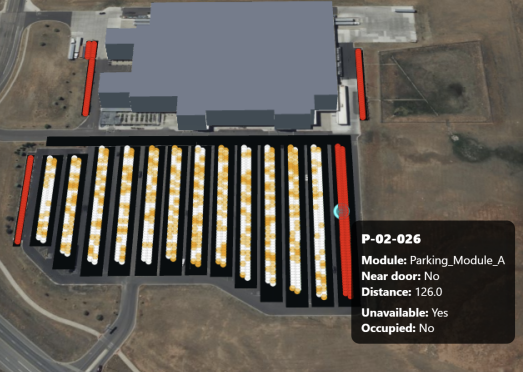
How I read the results
PANDA focuses on what happens after occupancy has been observed: forecasting how the facility will change and exposing those forecasts spatially. The joint model avoids maintaining a separate predictor for every time horizon and turnover task, which makes repeated digital-twin synchronization more practical.
Current scope
PANDA currently uses Markov-generated occupancy data calibrated from public patterns. The next phase will validate the framework with live parking sensors, heterogeneous streams, and behavioral simulation.
Inside the system
Where I am taking it next