Realistic data generation
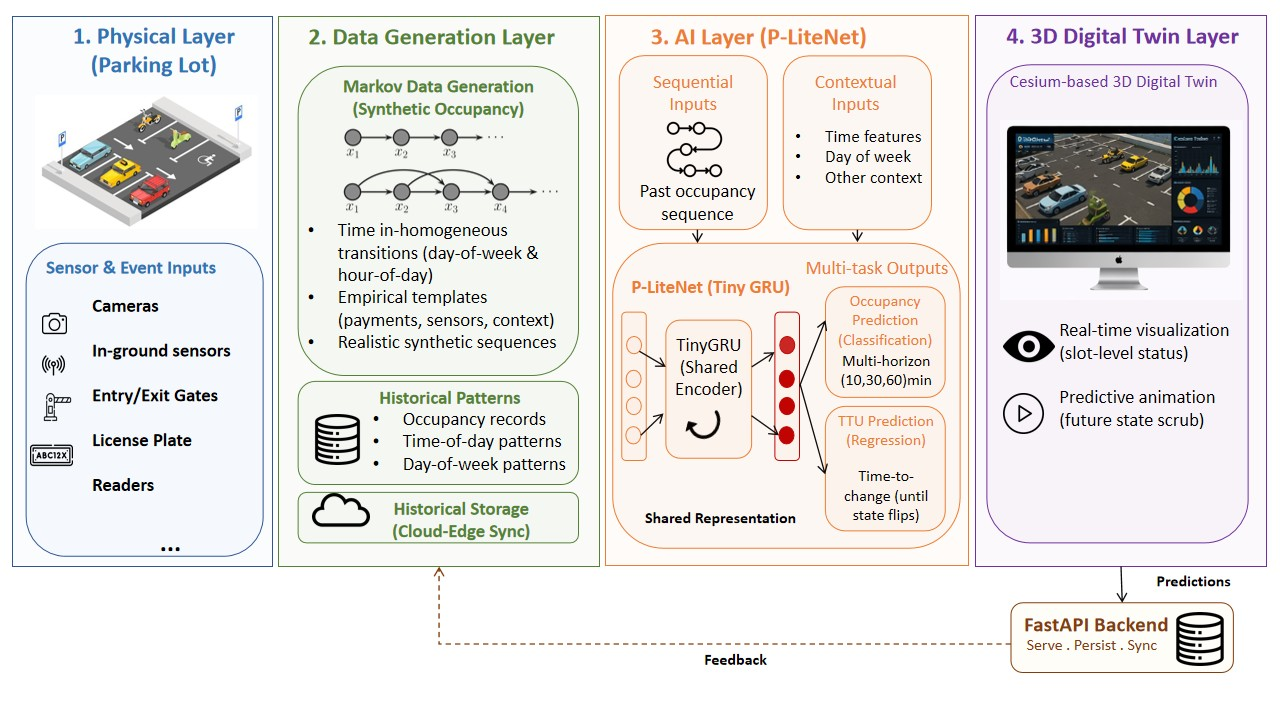
A time-inhomogeneous Markov process learns time-varying parking transitions and synthesizes occupancy patterns with contextual signals.
Predictive smart parking
Can a parking digital twin move from showing what is occupied now to helping operators anticipate what happens next?
Presented virtually at ASCE i3CE 2026
How can facility-scale parking twins provide multi-horizon occupancy and turnover forecasts when local data and computing resources are limited?
PANDA is a lightweight digital twin framework for predictive management of retail parking facilities. It addresses a practical problem: smaller deployments often lack long historical records and cannot support large forecasting pipelines.
The framework connects synthetic data generation, a compact multi-task forecasting model called P-LiteNet, and a geospatially accurate Cesium environment. The result is a twin that visualizes both current and predicted parking states for operational decision support.
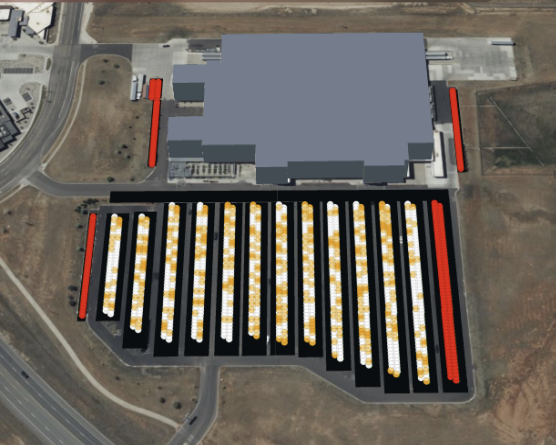
The Cesium-based facility twin maps predicted states to parking modules and individual spaces for rapid operational interpretation.
A time-inhomogeneous Markov process learns time-varying parking transitions and synthesizes occupancy patterns with contextual signals.
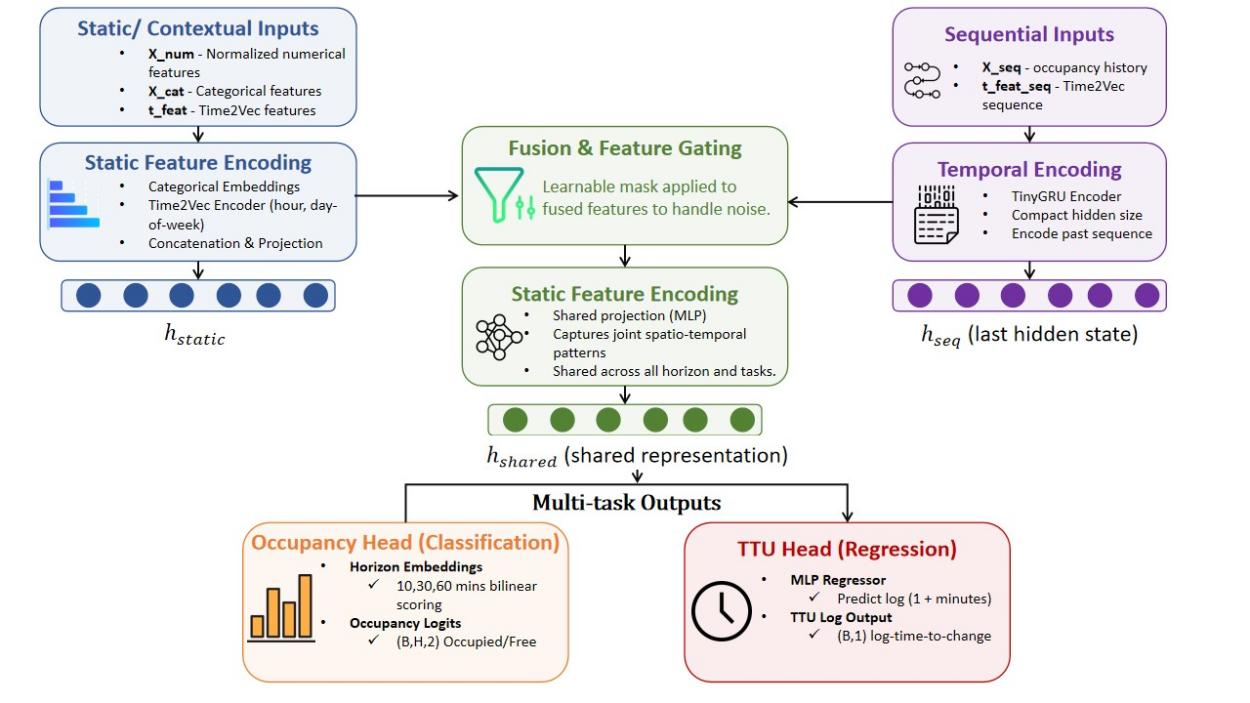
A 156K-parameter TinyGRU architecture jointly predicts multi-horizon occupancy and time-to-change instead of maintaining separate models for each horizon.
Forecasts are synchronized with individual parking entities in a 3D geospatial environment for slot-level and module-level exploration.
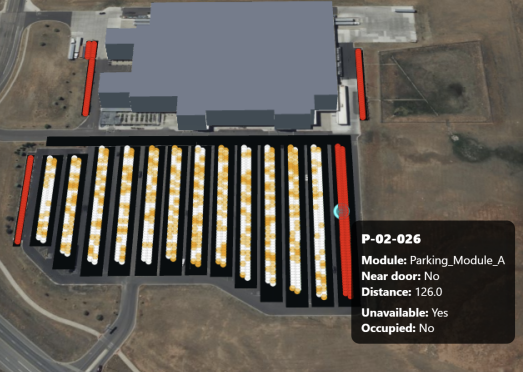
PANDA focuses on what happens after occupancy has been observed: forecasting how the facility will change and exposing those forecasts spatially. The joint model avoids maintaining a separate predictor for every time horizon and turnover task, which makes repeated digital-twin synchronization more practical.
PANDA currently uses Markov-generated occupancy data calibrated from public patterns. The next phase will validate the framework with live parking sensors, heterogeneous streams, and behavioral simulation.
The next stage is validation with real occupancy sensors, heterogeneous data streams, and agent-based behavioral simulation for testing access, turnover, and capacity policies.